


Reading and Phonics
Early Reading – Phonics
At Discovery Primary Academy, we believe that reading is the key to all learning. It is the foundation upon which all other learning is built, shaping children into confident and curious learners. We are committed to ensuring that every child becomes a confident, fluent reader who develops a lifelong love of reading. Using the FFT Success for All (SFA) Phonics and Reading programme, our curriculum is designed to deliver a systematic, structured and inclusive approach to early reading and literacy development.
Our Phonics Intent
Our intent is to ensure that all children, regardless of starting point or background, acquire the essential phonics knowledge, decoding skills, vocabulary and comprehension strategies necessary to read accurately, fluently and with understanding. SDA provides a researched informed, consistent and cumulative approach that enables children to make rapid and sustained progress. Through daily, high quality phonics instruction and carefully sequenced reading lessons, children are taught to:
- Develop a secure phonemic awareness and phonics knowledge.
- Apply decoding skills confidently when reading unfamiliar texts.
- Build fluency, expression and stamina.
- Develop comprehension through discussion, questioning and vocabulary development.
- Experience success and enjoyment in reading from the earliest stages.
Implementation – How do we teach phonics and early reading?
In EYFS and Year 1, the SFA programme is delivered with fidelity, adhering to the SFA lesson structure, routines and teaching sequence. Phonics is taught daily through carefully sequenced lessons which explicitly teach grapheme-phoneme correspondences (GPCs), blending, segmenting and word reading. Lessons follow the SFA instructional routines, ensuring consistency, clarity and pace across all classes. Children are grouped flexibly according to ongoing assessment, allowing teaching to be precisely matched to need while maintaining fidelity to the programme.
Children are first taught the most common GPCs in the English language so that they can quickly begin to apply this knowledge to read whole words (blending), and soon after, to spell them (encoding). Over the course of the programme, they will be introduced to a number of alternative ways of representing the same phonemes, including some of the less common GPCs. Phonics lessons follow a consistent daily structure. This consistent approach enables lessons to be taught with pace as everybody understands the routine and what is expected. The 25- minute lesson follows the same basic sequence each day:
- Review previously learnt GPCs (10 minutes).
- Teach, practise and apply the new GPC (15 minutes).
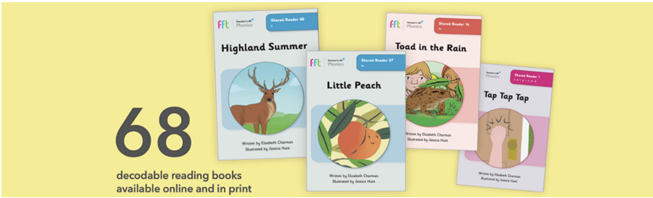
It is important that children don't simply know their phonics but can apply that knowledge to the skill of reading itself. In the SFA programme, children apply their developing phonic knowledge and skill by reading the shared readers. These are carefully aligned to the phonics lessons and allow children to practise reading the new and recently taught GPCs as well as the Common Exception Words to which they have been introduced. There are 68 fully decodable reading books to support the effective teaching of phonics from Reception to the end of Year 1. Each Shared Reader is designed to be read over five days.
Each reading session gives an opportunity for children to revisit previous learning, be taught new skills, practice together through paired reading and apply what they have learnt and discuss the text. It follows the principles of
- Revisit and Review
- Teach and Model
- Practise and Apply
- Discussion and Comprehension
Impact – How is progress shown?
Through the consistent, systematic and daily teaching of phonics we are committed to all children becoming fluent, confident and enthusiastic readers and writers. The impact of phonics teaching is evident through all areas of learning. Childre have opportunities to apply their phonetical knowledge to other subjects and develop their fluency and comprehension as they progress through school. Phonics attainment is measured through The Phonics Screening Test, regular phonics assessments, Reading and Writing Early Learning Goal (EYFS) and reading colour bands.
Reading
We aim to inspire and foster a love of reading amongst our children. Reading is fundamental to the development of children and the foundation for their learning throughout their time at school. We develop this love through exposing children to a range of high quality texts in our reading lessons, our school and class libraries and a range of theme days and weeks.
Our Reading Intent
Alongside phonics lessons, children in KS1 and KS2 take part in daily reading lessons. In Year 2, children follow the SFA 'Roots to Reading' programme. Daily reading sessions build on children's phonics knowledge, decoding, fluency and comprehension skills from Year 1.
Our Key Stage Two reading follows the CUSP curriculum (Curriculum with Unity Schools Partnership) and is deliberately designed to be ambitious and aspirational, ensuring that every child leaves our school a competent, confident reader. Children are exposed to an extensive range of diverse, high quality, fiction and non-fiction texts which cover a range of relevant social issues, big ethical questions and moral dilemmas. Children will read not just with fluency and understanding but with enjoyment and confidence as the evidence-based structured learning sequence explicitly teaches the core reading strategies. Children's reading attainment will be assessed to identify and close gaps quickly and effectively. Through the quality of texts and teacher modelling, children will be supported in developing their conceptual fluency, prosody and language across the curriculum to prepare them for future demands and develop the necessary cultural capital.
Implementation – How do we teach reading?
In EYFS and KS1 and KS2 (where appropriate) decoding, blending and comprehension skills are taught through SFA. Through this curriculum, children are provided with materials which are closely matched to their phonics knowledge.
In Year 2, daily reading lessons develop the progression from decoding to increased fluency through high-quality modelling, practise and application across the programme. Children have opportunities to read for deeper meaning and improve their vocabulary and comprehension skills. During daily reading sessions, children learn to:
- Build background
- Make predictions
- Check and understand key vocabulary
- Clarify for meaning and understanding
- Ask and answer questions
- Summarise what they have read
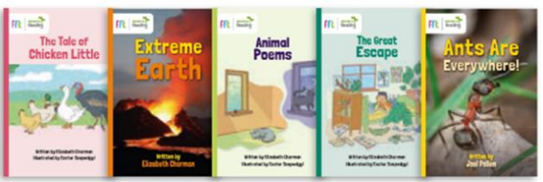
In Years 3-6, CUSP reading is built on three key foundations: explicit vocabulary instruction; explicit fluency instruction (prosodic reading) and opportunities to think hard. Every unit follows a clear and progressive sequence that immerses children meaningfully in rich and demanding texts that have been carefully curated.
Year 3

Year 4

Year 5

Year 6

Children will receive daily reading teaching that ensures all children develop:
- Fluency and Prosodic Reading – The ability to read accurately, at an appropriate speed, with phrasing and expression.
- Explicit Vocabulary Knowledge – Systematic instruction in rich and sophisticated language.
- Comprehension and Critical Thinking – The ability to infer, summarise, analyse authorial intent and make connections across texts and themes.
- A love of Literature – High quality texts carefully sequenced to expose children to a diverse range of authors, themes and styles to foster a life-long love of reading.
Children who require further additional support (catch-up) are identified using a range of assessment information and will be supported through small group or one-to-one interventions such as Tutoring with The Lightning Squad, a reading tutoring programme where children work in small groups with a tutor to improve their reading skills. The tutoring is a blended approach with face-to-face tutoring supported by an online tutoring platform. The tutoring activities are designed and structured to improve reading skills, fluency, comprehension, spelling and phonics.
Impact – What does progress look like?
Children will have developed conceptual fluency and comprehension skills which they can use and apply across a range of subjects, lessons and in the wider world as they continue their educational journey. Through exposure to the diverse literature spine, children become inclusive, compassionate and aspirational citizens in the wider community.
When children leave Discovery Primary Academy, they will...
- Have a love for reading.
- Be exposed to and enjoy reading a range of texts.
- Read with fluency and prosody.
- Be able to read and discuss an increasingly wide range of fiction, poetry, plays, non-fiction and reference books or textbooks.
- Make comparisons within and across books.
- Discuss and evaluate how authors use language, including figurative language, considering the impact on the reader.
- Be able to write for a range for audiences andpurposes using accurate grammatical features and a wide range of ambitious and effective vocabulary which draws on what they have read as models.
Phonics and Reading work collaboratively as one subject. Please see more information on our phonics curriculum which is specific to our Success for All phonics programme.